
Find what you actually
have exposed.
AutoScan is continuous external attack surface monitoring (ESAM) and validation, not another checkbox scan. A nightly continuous scan maps everything you have exposed to the internet, then proves what is actually exploitable with real exploitation: unauthenticated APIs, vulnerabilities, open ports, TLS errors, admin panels, default credentials, IDOR, SQL injection, SSRF, and more. Every priority finding is signed off by a senior security engineer, in an auditor-accepted report. In the beta, we include AI-suggested fixes with detailed instructions.
Backend launching soon · Join the waitlist for early access
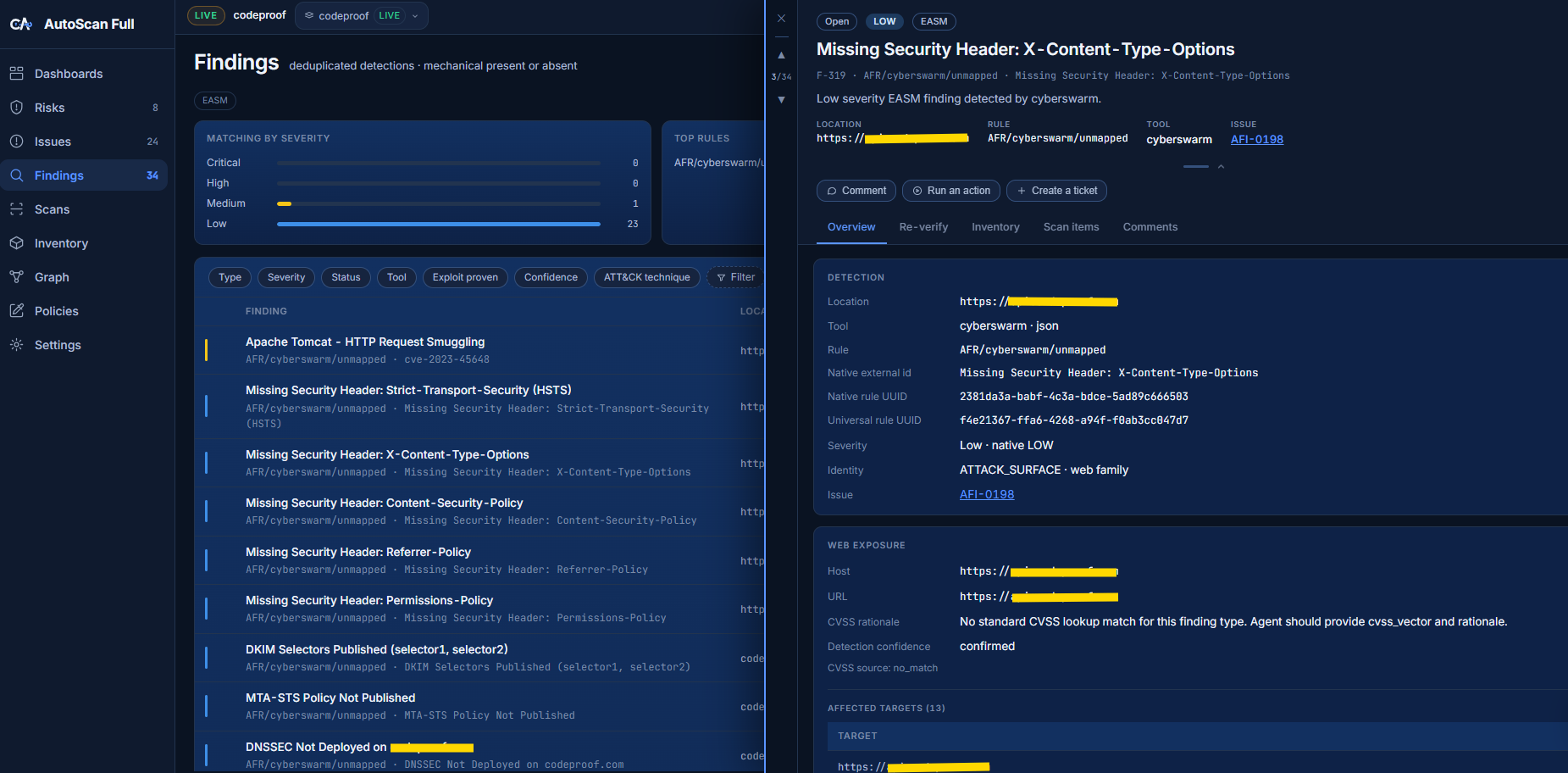
Findings deduplicated and prioritized by real exploitability, each with evidence and remediation.
How It Works
Enter a domain. We handle the rest.
No scheduling. No waiting room. No $15,000 invoice. Pentest, then verify your fixes held.
Enter a Domain and Go
Enter your domain and we handle the rest. Prove ownership with a quick DNS TXT record, the same way Google Search Console works. Optionally add IP ranges or specific subdomains to scope.
AutoScan Attacks Your Surface
AI agents orchestrate hundreds of specialized tools across thousands of assets, actively attempting exploitation, not just scanning. Default credentials tried. SQL injection payloads sent. Real evidence collected.
Auditor-Ready Report in 20 min
Executive summary plus technical findings with evidence. Every HIGH and CRITICAL finding reviewed by a senior security engineer before sign-off. SOC 2 / ISO 27001 accepted.
Fix, Then Verify
The moment you ship a fix, re-scan the selected findings to confirm each one is actually resolved. No new engagement, no extra fee. Your surface is monitored as it changes, not captured once.
Coverage
What we test.
Comprehensive external coverage with active exploitation, plus nightly continuous surface monitoring as your assets change.
Network & Ports
- Open port exposure
- Unprotected admin interfaces
- Unauthenticated services
- Firewall bypass vectors
Web Application
- OWASP Top 10 coverage
- SQL & command injection
- XSS & CSRF detection
- SSRF & auth/session flaws
API Security
- Unauthenticated API endpoints
- Broken object-level auth (IDOR / BOLA)
- Broken function-level auth
- Excessive data exposure
TLS & Certificates
- Deprecated TLS 1.0/1.1
- Weak cipher suites
- Certificate expiry
- HSTS & cert chain
DNS & Email Security
- Subdomain takeover
- Dangling CNAME records
- SPF / DKIM / DMARC
- Email spoofing risk
Cloud & Infrastructure
- Public S3 / GCS buckets
- Cloud credential exposure
- IMDS credential theft
- Misconfigured storage
Security Headers
- Missing HSTS
- No CSP policy
- X-Frame-Options absent
- Clickjacking exposure
Real findings
What AutoScan finds.
A sample of anonymized findings from recent scans. Every finding is grounded in concrete evidence, and in the beta each one ships with an AI-suggested fix and detailed instructions.
Unauthenticated API endpoint exposes data
An API endpoint returned records without requiring authentication. The data could be read directly.
Broken object-level authorization (IDOR / BOLA)
Object identifiers could be changed to read data belonging to other accounts.
Deprecated TLS 1.0 enabled
The origin still negotiates TLS 1.0, a protocol deprecated for known cryptographic weaknesses.
DMARC policy set to p=none
DMARC is published but set to p=none, so spoofed mail from the domain is not rejected.
Session cookie missing HttpOnly and SameSite
A session cookie lacked HttpOnly and SameSite, widening the impact of XSS and CSRF.
Missing Strict-Transport-Security (HSTS)
No HSTS header, leaving a window for protocol-downgrade and SSL-strip attacks.
Missing Content-Security-Policy
No CSP header to constrain script sources and blunt cross-site scripting.
Missing X-Content-Type-Options
Responses did not send nosniff, allowing MIME-type confusion attacks.
SPF record not in strict mode
SPF ends in ~all (softfail) instead of -all, weakening protection against spoofing.
MTA-STS policy not published
No MTA-STS policy, so inbound mail can be delivered over unauthenticated or downgraded TLS.
DNSSEC not deployed
The DNS zone is not signed with DNSSEC, so DNS responses can be tampered with in transit.
Missing Referrer-Policy and Permissions-Policy
No Referrer-Policy or Permissions-Policy to limit referrer leakage and browser feature access.
Anonymized examples. Targets, hosts, and customer details are never shown.
Why Agentic AI Pentesting
AI scale. Human judgment.
Faster. Consistent. Verified.
Manual pentesting has a people problem: scarce senior talent, firms booked out months, quality that varies by tester. AutoScan runs at AI scale and routes every priority finding through a senior security engineer. Speed without giving up judgment.
AutoScan - AI Pentest
- Results in 20 minutes - No scheduling, no kickoff calls, no waiting weeks for a slot. Start now, report in 20 minutes.
- Always consistent - Every scan runs the same checks with the same rigor. No variation between testers, no bad days, no shortcuts.
- No access or trust issues - Domain verification via DNS TXT record. No VPN access, no shared credentials, no keys handed over.
- Evidence-backed, zero noise - Every finding was actively exploited. The report contains proof, not theoretical risk scores or scanner dumps.
- Senior engineer verification - Every HIGH and CRITICAL finding is reviewed and signed off by a named security engineer before the report is finalized. No AI-only findings.
- Verify your fixes with a re-scan - Ship a fix, then re-scan the selected findings to confirm each one is actually resolved. No new engagement, no extra fee, no scheduling delay.
- Comprehensive coverage and monitoring - Full external attack surface coverage, monitored continuously as your assets change. Not a one-day snapshot.
- SOC 2 / ISO 27001 accepted - Auditor-accepted PDF with scope, methodology, findings, and remediation. Built for compliance.
Traditional Manual Pentest
- 2-4 weeks to schedule - Kickoff calls, scoping meetings, NDA negotiation, and scheduling coordination before a single test runs.
- Scarce senior talent - (ISC)² estimates roughly 4M unfilled security positions globally, with offensive specialists the scarcest subset. Top firms are booked months out.
- Quality varies by tester - Skill levels differ across engagements. A junior tester on a tight deadline can miss what a senior catches.
- Significant trust exposure - You share VPN credentials, API keys, admin access, and internal architecture with a team you just met.
- Mostly offshore delivery - Many firms use offshore teams for execution. US rates, offshore delivery, less accountability.
- Re-test costs extra - Fixed a critical issue? A re-test is a new engagement. More scheduling, more cost, more delay.
- Point-in-time snapshot - A single engagement captures your posture on one day. Your attack surface changes every day.
On trust: Manual pentests require you to hand over VPN access, API keys, admin credentials, and internal network diagrams to a team you just met. AutoScan verifies ownership via a DNS record - the same mechanism Google uses. We never see your credentials, never enter your internal systems, and never touch anything you have not explicitly authorised.
Why AutoScan
Compared to the alternative.
| AutoScan | Manual pentest firm | Vuln scanner | |
|---|---|---|---|
| Time to first result | 20 minutes | 2-4 weeks | Hours |
| Price | Contact us | $15K-$50K | $5K-$50K/yr |
| Active exploitation | |||
| Human verification of priority findings | |||
| Executive summary | |||
| Re-test after fixes | Extra fee | ||
| Zero false positives | |||
| SOC 2 / ISO 27001 |
FAQ
Common questions.
Get Started
Know what attackers
can see. Right now.
Free during beta. Join early access, we respond within 1 business day.