
AI pentest vs manual pentest: a factual comparison
A neutral, factual comparison of agentic AI penetration testing and traditional manual pentests. Cost ranges, time-to-report, coverage by vulnerability category, compliance acceptance, and where each one is genuinely better than the other.
TL;DR
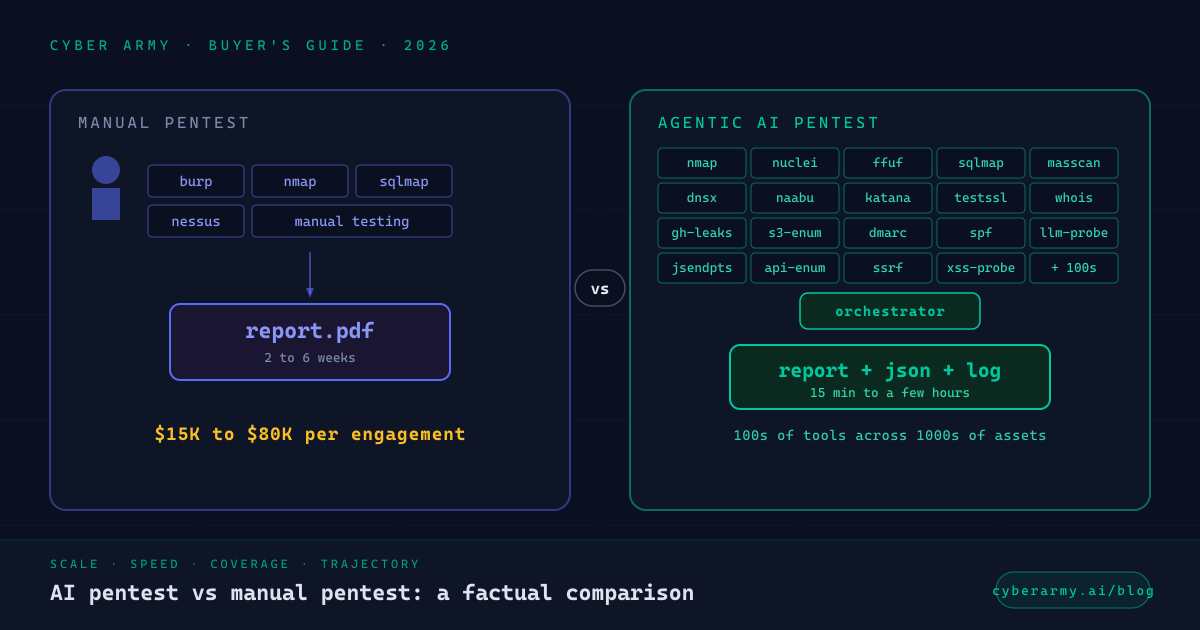
Manual pentests are slower (2-6 weeks), priced per engagement ($15K-$80K typical for external web/app), and run once or twice a year. They're currently better at business-logic and authenticated-context bugs that automation still misses. Agentic AI pentests are fast (minutes to hours), subscription-priced rather than per-engagement, and run continuously - wide-surface, frequent, reproducible.
The trajectory matters more than the snapshot. Manual pentest's structural problems - talent scarcity, rising cost, scheduling friction, data-exposure risk from third-party access - don't improve over time. Agentic AI's capabilities improve every model release; what frontier models couldn't do in 2024 they do routinely in 2026. The category that compounds wins.
The pattern most teams are converging on: agentic AI continuous coverage plus human expert verification of priority findings. AI does the breadth, frequency, and mechanical work; a senior security engineer reviews HIGH and CRITICAL findings before they reach the customer, eliminating the false-positives-at-the-top problem that pure-AI scanners have. That's the model AutoScan ships.
What each term actually means
Manual penetration testing (also called "human pentest" or "traditional pentest") is a security assessment performed by qualified human testers, usually over a fixed engagement window. A typical external web pentest runs 1-3 weeks of active testing plus another 1-2 weeks of report writing. Testers use a mix of commercial tools (Burp Suite, Nessus, Nuclei), custom scripts, and hands-on exploitation. The deliverable is a written report with findings, evidence, severity ratings, and remediation guidance.
AI penetration testing - sometimes called agentic AI pentest, autonomous pentest, or automated penetration testing - uses large language models orchestrated as multi-agent systems to perform the same workflow. A typical AI pentest spins up agents that handle discovery, exploitation attempts, evidence collection, and report writing, often in parallel. The deliverable is an auditor-ready report produced in minutes to hours rather than weeks.
The distinction matters because automated is doing a lot of work in "automated penetration testing." Legacy vulnerability scanners (Nessus, Qualys, Rapid7 InsightVM) are automated too, but they pattern-match against known CVEs and don't actually attempt exploitation. AI pentest platforms attempt exploitation the way a human would: they reason about what should work, try it, observe the result, and revise. That distinction is what separates the new category from a glorified vulnerability scanner.
Side-by-side comparison
| Dimension | Manual pentest | AI pentest |
|---|---|---|
| Time to report | 2-6 weeks typical | 15 minutes to a few hours |
| Pricing model | $15,000 - $80,000+ per engagement (external web/app) | Subscription, varies by vendor; scales with attack-surface size and scan cadence |
| Frequency | Annual or quarterly | Per-commit, daily, or continuous |
| Coverage breadth | Deep on chosen scope; narrow | Wide across surface every scan |
| Reproducibility | Tester-dependent | Identical methodology every run |
| Authenticated testing | Standard | Limited or absent in current generation |
| Business-logic flaws | Strong | Weak |
| Novel attack chains | Strong (creative humans) | Improving rapidly |
| False positive rate | Low (~0-2%) | 2-8% typical, depending on platform |
| Compliance acceptance | Universal | Growing; SOC 2 and ISO 27001 accept it; PCI-DSS still requires human attestation for some controls |
| Audit trail | Written report; tester notes | Machine-readable JSON + chain-of-custody log |
Where manual pentest is currently stronger
Four categories where a human pentester delivers something agentic AI doesn't yet match. The word yet is doing real work in that sentence - the gap on each of these has narrowed measurably between 2024 and 2026 as frontier models have improved, and the Mythos research demonstrates that even the hardest categories on this list (novel multi-step chains, deep reasoning across an unfamiliar codebase) are now within AI's reach in many contexts.
Business-logic flaws
The hardest bug class to find automatically is the one where every individual request looks legitimate but the sequence creates a vulnerability. A discount code that doesn't verify cart contents until checkout. A multi-step wizard where step three trusts state from step two. An order-fulfillment workflow where rapid-fire requests trigger a race that lets one user's payment apply to another's order. These bugs require understanding what the application is supposed to do - not just whether each endpoint validates input properly.
A human tester reads the app, forms a mental model of its purpose, and probes for places where the model and the implementation disagree. AI agents can do this, but they're weaker at it than at memory-corruption or injection-class bugs, because the oracle ("is this actually wrong?") is judgment-based rather than sanitizer-based.
Deep authenticated testing
OWASP Top 10 categories like A01: Broken Access Control and A04: Insecure Design often manifest only after a user logs in. IDOR (Insecure Direct Object Reference) attacks, privilege escalation between user roles, session-management flaws, and post-auth CSRF all require the tester to have valid credentials and exercise the app from inside.
Most current-generation AI pentest platforms test from the outside without credentials. Some support session injection, but doing it well - handling multi-step login, CAPTCHA, MFA, custom session management - is hard enough that few platforms do it reliably yet. A manual tester just logs in.
Novel attack chains
A creative tester chains together three medium-severity findings into one critical exploit path. This login form leaks usernames via timing. This password-reset flow lets us reset any account if we know the username. This admin panel is reachable only after one password reset. Each finding alone is medium; together they're a takeover of every account.
AI agents are getting better at this - the Mythos research shows frontier models are now chaining multi-step exploits autonomously in many contexts - but the state of the art for AI chaining is still behind the state of the art for human creativity on a fresh target.
Adversary simulation and red teaming
Full red team engagements simulate a sophisticated threat actor over weeks or months - physical access attempts, phishing, custom malware, social engineering, lateral movement after initial access. This is not penetration testing in the narrow sense; it's adversary simulation. AI pentest platforms don't do this and aren't trying to. If you need a red team, you hire a red team.
Why manual pentest's lead doesn't compound
The trickier question for security leaders isn't which approach is better today - it's which approach gets better over time. On that question manual pentest faces structural problems that have nothing to do with tester skill and everything to do with the format itself.
The talent gap is structural, not cyclical
The (ISC)² Cybersecurity Workforce Study has been reporting a global shortage of trained security professionals for years - the 2024 edition put the gap at approximately 4 million unfilled positions worldwide, with offensive-security specialists (the kind who do pentests) the scarcest subset. Pentester salaries reflect this: senior consultants at boutique and tier-1 firms regularly bill at $300-$500/hour, and the supply isn't catching up to demand.
This isn't a market that resolves itself in a few years. Training a senior pentester is a 5-to-10-year arc, and the universities and bootcamps cannot scale fast enough to fill the gap. Every year the supply-demand ratio worsens, and engagement pricing follows.
Cost is on the wrong side of the curve
Manual pentest cost is bounded below by senior security engineer salaries - a number that compounds with general inflation, with security-specific wage inflation, and with the talent scarcity above. Across the last decade the median external web pentest price has roughly doubled. There's no reason to expect that trend to reverse.
Agentic AI pentest cost moves the opposite direction. Model API pricing has fallen consistently as inference efficiency improves; the same capability that cost dollars per call in 2023 costs cents per call in 2026, and the trend continues. Whatever the cost gap looks like today, it widens in AI's favor every year.
Scheduling friction caps your testing cadence
Top pentest firms are booked out 3-6 months. A finding from a manual engagement gets a remediation cycle that's also months long - fix, wait for re-test, get re-test scheduled, get re-test report. By the time the cycle closes, the codebase has shipped 20 new features and the original engagement is a snapshot of code that no longer exists. AI pentest can re-run on demand and treats "test the fix on Monday, ship the fix on Tuesday" as the normal cadence rather than a rare luxury.
Third-party access is a real exposure surface
A manual pentest engagement typically means giving outside contractors access to your code, your infrastructure, sometimes your credentials. The pentest firm is bonded and reputable, and incidents are rare, but they're not zero. Pentest engagement notes, finding details, and access tokens have all leaked from well-known firms in the last few years.
More commonly, the risk shows up in indirect ways: pentest reports stored insecurely after delivery, contractor accounts that don't get properly off-boarded, screenshots of customer data that linger in someone's personal cloud. AI pentest runs against your perimeter from the outside - no granted access, no codebase share, no credential injection. The third-party data-exposure surface is roughly nil by construction.
Quality variance is structural, not addressable
Two human pentesters working the same target produce different reports. Some testers go deep on what they know best and miss what they don't. Some firms front-load senior consultants on the sales pitch and back-load juniors on the actual engagement. You can't see this in advance; you see it in the deliverable.
Agentic AI pentest runs identical methodology every time. Year-over-year comparison is signal, not tester variance. When the platform improves, every customer's next scan inherits the improvement.
Capability follows the model curve, not the headcount curve
The strongest argument against manual pentest's long-term position is the rate of capability improvement on the other side. Each frontier model release lifts agentic AI pentest's capability in every category it touches - including the categories above where manual currently leads. The Mythos research from Anthropic's Frontier Red Team is the clearest example: in less than two years, AI vulnerability discovery moved from "sometimes plausible suggestions" to "routinely surfaces 17-year-old CVEs in heavily-fuzzed code, autonomously builds working exploit chains, and produces auditor-acceptable evidence."
The categories where manual pentest currently leads - business logic, authenticated context, novel chains - are the categories where every new model release shows the most improvement. Manual pentest skill doesn't get measurably better year-over-year. Agentic AI does.
Where AI pentest wins
Speed and turnaround
The shortest manual pentest is roughly two weeks of testing plus one week of report writing - say, 15 working days from kickoff to PDF. The longest is 6-8 weeks. An AI pentest delivers a comparable-format report in minutes to a few hours.
This isn't just a convenience improvement. It changes what's possible. A finding from Tuesday's scan can be fixed by Thursday and re-verified by Friday. With a manual pentest the same loop is months long; by the time the report lands, half the findings reference code that's already been refactored.
Cost economics
External web pentests from established vendors (Cobalt, Synack, Bishop Fox, NCC Group, Praetorian) typically price between $15,000 and $80,000 per engagement, depending on scope, depth, and reporting requirements. Smaller boutique firms can be cheaper; tier-1 firms can be much more expensive for complex scopes. Cobalt's State of Pentesting report tracks these ranges across the industry.
AI pentest platforms typically price by annual subscription rather than per-engagement, with cost driven by attack-surface size, scan cadence, and depth tier. Pricing varies meaningfully across the category; vendors publish ranges rather than fixed numbers. The directional shift that matters: one annual manual pentest's budget typically funds a year of continuous AI pentest coverage. That economic flip - from per-engagement billing to continuous coverage at a comparable annual budget - is what makes continuous testing feasible for the first time.
Coverage breadth
A manual pentest is scoped before the engagement starts. The customer agrees to N domains, M IP ranges, and a defined methodology. Everything outside scope is invisible. If the team forgot to include a marketing subdomain that runs an old WordPress install, the pentest won't find the WordPress bug.
AI pentests are cheap enough to scan everything every time. Discovery runs from scratch on every scan, surfacing shadow IT, forgotten subdomains, and newly-deployed services that the human-scoped engagement would have missed. The breadth-per-dollar advantage is large.
Reproducibility and audit trail
Two human pentesters working the same target produce different reports. They have different specializations, different intuitions, different tool preferences. This is fine for finding bugs but bad for measuring progress - "is our security better than last year?" depends partly on which tester you had.
AI pentests run identical methodology every time. The methodology is logged. Every tool invocation is recorded with its full command, duration, and output. Year-over-year comparison is straightforward: same scanner, same gates, same scoring; difference in findings is genuine signal about your security posture, not tester variance.
Compliance velocity
SOC 2 Type II requires that the auditor see evidence of regular security testing. Quarterly is acceptable; annually with continuous monitoring is acceptable. For a small startup pursuing SOC 2 Type II for the first time, manual pentest costs can be a meaningful percentage of the audit budget. AI pentest reports - ones that include full evidence chains and methodology documentation - are increasingly accepted as the "regular testing" control evidence. The exact stance varies by auditor; the trend is toward acceptance.
What manual physically can't cover
The framing "manual pentest is more thorough" assumes humans cover everything an AI pentest covers, plus the creative work on top. In practice that's not true. A two-week manual engagement has to make hard scoping choices because the alternative is leaving testing budget on the table. Several entire categories of work routinely fall out of scope, not because they aren't valuable but because they don't fit a human's time budget at engagement prices.
What an AI pentest can cover on every run, that a manual pentest realistically can't fit in:
- Exhaustive subdomain enumeration. Certificate transparency logs, DNS brute force, search-engine pivots, passive sources. A typical mid-size company has hundreds of subdomains; a manual pentester gets a list of 5-10 and tests those. AI pentest discovers the full surface every scan, catches shadow IT, and flags newly-deployed subdomains the team forgot about.
- Full-port scanning across the discovered IP range. Manually port-scanning every customer IP across ports 1-65535 takes hours; in practice manual engagements test a handful of known services on standard ports. AI pentest runs two-phase port discovery on every IP, every run.
- API endpoint extraction from JavaScript bundles. Single-page apps hide most of their API surface in compiled JS. Manually parsing every
.jsbundle to extract/api/*routes, then testing each one for auth gaps, is the kind of work that's theoretically possible but almost never fits an engagement. AI pentest does this on every web scan. - Email security posture (SPF / DKIM / DMARC / MTA-STS / DNSSEC). Five minutes per domain manually; almost never included in standard external pentests because nobody pays $15K to check DNS records. AI pentest checks all of these on every brand-owned domain every run.
- WHOIS and typosquat monitoring. Discovering look-alike domains registered against your brand, monitoring expiration on critical registrations - manual work that's skipped in standard engagements. Automated continuously.
- TLS posture across the full subdomain set. Certificate chain, supported cipher suites, HSTS, weak protocols - five minutes per subdomain. For an org with 200 subdomains that's 16+ hours of pure mechanical work. Manual pentests spot-check a few; AI pentest does all of them.
- Container registry enumeration. Public Docker Hub, GHCR, Quay searches against the customer's organization name. Almost never in scope for a manual external pentest. AI pentest does it on every run because it's cheap and frequently turns up real exposure.
- OSINT-grade leaked-secrets hunting across public GitHub. Exhaustive code-search for hardcoded API keys, AWS credentials, internal repo references. Hours of manual work per engagement; routinely skipped. AI pentest does it on every run, with live validation of any keys it finds.
- Cloud bucket discovery. S3, Azure Blob, GCS bucket enumeration by brand-name patterns. Mechanical, time-consuming, and rarely in manual scope. AI pentest treats this as a baseline check.
- Live exploitation across the full finding set. A manual pentester triages findings and exploits a few representative ones because each exploitation takes time. AI pentest can attempt active exploitation on every finding that warrants it (with benign payloads), promoting findings from "suspected" to "confirmed" at scale.
None of this is a knock on manual pentest skill. It's a scoping reality. A two-week engagement at $30,000 is making roughly $300/hour decisions about where the time goes, and broad-surface mechanical checks lose those decisions to deep work on the application proper. That's the right tradeoff for the engagement format. It just leaves a lot of real exposure uninspected - exposure that AI pentest, with effectively unlimited cycles for that price, can cover routinely.
The scale gap is hard to overstate. A frontier-grade agentic pentest run orchestrates hundreds of specialized tools - port scanners, service fingerprinters, CVE template engines (nuclei), web fuzzers (ffuf), SQL-injection probes (sqlmap), TLS and DNS analyzers, JavaScript endpoint extractors, OSINT scrapers, GitHub secret hunters, cloud-bucket enumerators, AI/LLM surface detectors, and dozens more - across thousands of assets per engagement (subdomains, IP-port combinations, URL endpoints, leaked-secret candidates, public repository references). A senior human pentester running one tool at a time on one target at a time covers a tiny fraction of that surface in two weeks. It isn't a question of skill; it's a question of physics.
The qualitative jump from older automated scanners is that the modern agentic loop decides where to go deeper based on what it finds. A first-pass discovery surfaces a vulnerable-looking endpoint; the system queues active SQL injection probing against it. A leaked AWS key turns up in a public repo; the system queues live validation against AWS APIs. A service banner suggests an unpatched CVE; the system queues an exploit-template check. That conditional "broad-then-deep based on signal" pattern is what separates 2026-era agentic pentest from previous generations of vulnerability scanners - it didn't work reliably in 2024; it works routinely now.
Coverage by vulnerability category
A more granular look at where each approach is strong, weak, or roughly equivalent:
| Category | Manual pentest | AI pentest |
|---|---|---|
| Injection (SQLi, command injection) | Excellent | Excellent - sqlmap and similar tools used directly |
| Cross-site scripting (XSS) | Excellent | Excellent |
| Server-side request forgery (SSRF) | Excellent | Strong on standard patterns |
| Insecure direct object reference (IDOR) | Excellent | Weak without auth context |
| Broken authentication / session | Excellent | Limited; depends on auth support |
| Security misconfiguration | Strong | Excellent - broad surface coverage |
| Sensitive data exposure | Strong | Excellent - leaked-secret pattern matching |
| Vulnerable components / known CVEs | Strong | Excellent - exhaustive CVE database checks |
| Cryptography misuse | Strong | Strong on common anti-patterns |
| Race conditions / TOCTOU | Strong (creative testers) | Improving; limited today |
| Business logic flaws | Excellent | Weak |
| Subdomain takeovers | Strong if in scope | Excellent - exhaustive every scan |
| TLS / DNS / DMARC posture | Strong | Excellent |
| Cloud misconfigurations (S3, etc.) | Strong | Excellent |
| OSINT-grade leak hunting | Strong with effort | Excellent - automated GitHub/PyPI scanning |
The pattern: manual is strong everywhere humans care; AI is strong everywhere the test is mechanical or broad-surface. The overlap is large. The gap is concentrated in business logic, authenticated context, and novel multi-step chains.
Cost: a closer look
Real pentest pricing varies significantly by scope, vendor, and depth. The ranges below reflect public guidance and customer reports across the industry.
Manual pentest cost ranges
- Small external web app pentest - single application, no auth: $5,000-$15,000 from boutique firms; $15,000-$30,000 from established firms.
- Standard external web app pentest - single application with auth, common features: $15,000-$40,000.
- Complex external app / API pentest - multiple apps, complex auth, business logic: $30,000-$80,000+.
- Network / infrastructure pentest - external network perimeter: $10,000-$30,000.
- Internal network pentest - assumed-breach scenario: $20,000-$60,000.
- Mobile app pentest - iOS + Android: $15,000-$50,000.
- Cloud configuration review - single AWS/GCP/Azure account: $10,000-$40,000.
These ranges align with industry data from Cobalt, Bugcrowd, and reseller surveys. Tier-1 firms (Mandiant, NCC Group, IOActive) typically price 2-3x the median; bug bounty platforms with continuous testing models can be lower per-engagement but charge subscription.
AI pentest cost ranges
AI pentest platforms are almost universally subscription-priced rather than per-engagement. Pricing varies meaningfully across the category: entry tiers are sized for small attack surfaces and standard scan cadences; higher tiers add surface scale, frequency, depth, integrations, and operational support. Vendors typically publish ranges rather than fixed prices, with annual cost driven by what gets scanned and how often.
The directional comparison most security teams care about: total annual cost for AI pentest-as-a-service generally lands meaningfully below an equivalent-coverage manual pentest program, with continuous testing instead of an annual snapshot. The exact cost depends on the vendor and your surface - but the structural shift is from per-engagement billing to continuous coverage at a roughly comparable annual budget.
Cost per finding
A median external web pentest produces 10-20 findings of varying severity. That works out to roughly $1,000-$3,000 per finding for manual at standard scoping. AI pentest cost-per-finding is meaningfully lower because each subscription covers many scans, each scan surfaces a finding set, and the surface inventory grows over time as discovery runs from scratch. The catch: not all findings are equal. A manual pentest's 15 findings are likely to include 2-3 that an AI pentest would have missed (business logic, authenticated context, creative chains).
Time to report
The timeline difference is the single biggest behavioral change AI pentest enables.
| Activity | Manual pentest | AI pentest |
|---|---|---|
| Kickoff and scoping | 1-2 weeks | Same-day for self-serve; 1-3 days for managed |
| Active testing | 1-3 weeks | 15 minutes to a few hours |
| Report writing | 1-2 weeks | Generated in seconds at scan end |
| Internal review and QA | 3-5 business days | Same-day if applicable |
| Customer delivery | Total: 4-8 weeks | Same-day to next-day |
| Retest after fixes | 1-2 weeks per round | Minutes per re-scan |
A manual pentest cycle (find, fix, retest, sign off) takes a quarter. An AI pentest cycle can take a week. For a SaaS company shipping features every sprint, this changes the math on what's feasible.
Frequency matters more than people think
The standard manual pentest cadence is once a year, sometimes twice for higher-stakes products. That cadence has a problem: your attack surface changes every week, and the time between pentests is the time during which new vulnerabilities live unfixed.
Consider three real scenarios:
- The supply chain attack scenario. A widely-used npm package is compromised on Monday. Your dependency installs the malicious version that afternoon. The manual pentest you scheduled for Q3 won't look at it until October. By then the attacker has had four months. The 2025-2026 supply chain attacks illustrate this gap repeatedly.
- The fresh-CVE scenario. A critical CVE drops for a service you run. The exploit is public within hours. Your last pentest didn't test it because the CVE didn't exist yet. Your next pentest is 8 months out. AI pentest can re-scan the day the CVE is published.
- The newly-deployed-surface scenario. A team spins up a new microservice for an experiment, forgets to take it down, and it ends up with default credentials and a port open to the internet. Manual pentest scope didn't include it. AI pentest's discovery phase finds it on the next run.
None of these scenarios are exotic. They're the median experience for a fast-moving engineering org. Annual snapshots can't address them; continuous testing can.
Compliance: what auditors actually accept
The question we get asked most: can I satisfy our audit with AI pentests? The answer depends on which audit.
- SOC 2 Type II. Requires evidence of "regular security testing." Does not prescribe manual versus automated. Most SOC 2 auditors accept a combination of vulnerability scanning, AI pentesting, and an annual manual pentest. Some accept AI pentest reports as the "penetration testing" control if the report includes evidence chains, methodology, and reasonable coverage breadth. Practice varies by auditor; ask yours.
- ISO 27001 / 27002. A.12.6.1 requires "technical vulnerabilities" to be managed. Like SOC 2, this is methodology-agnostic. AI pentest reports are increasingly accepted as part of the evidence package.
- PCI-DSS. Stricter. PCI-DSS 11.4 requires "internal and external penetration tests at least annually" with qualified personnel performing them. Current PCI-DSS guidance reads as expecting human-led testing for that specific control, although automated tooling can support it. Discuss with your QSA.
- HIPAA. No specific penetration testing requirement, but security management standards require risk assessment. Either approach can support the risk-assessment evidence chain.
- FedRAMP. Required pentests for FedRAMP Moderate and High follow specific NIST 800-115 methodology and are typically expected to be human-led, though tooling support is fine.
- Cyber insurance. Some insurers explicitly require an annual third-party manual pentest. Others accept continuous AI pentest reports. Read your policy.
The general trend across compliance regimes is acceptance of AI pentest reports as supporting evidence, with the most stringent frameworks (PCI-DSS Level 1, FedRAMP High) still expecting an annual human-led engagement. The pattern most teams converge on is "AI continuous + manual annual" - which satisfies every framework simultaneously.
When to pick which (or both)
When manual-only is the right answer
- You need PCI-DSS Level 1 or FedRAMP High compliance and your QSA / 3PAO expects human-led testing.
- Your application's security posture is dominated by business-logic and authenticated-context vulnerabilities (e.g., complex marketplace, multi-tenant SaaS with custom permission models, fintech with intricate workflows).
- You're running a red team engagement that simulates a sophisticated adversary across weeks or months. AI pentest is not a substitute for red team work.
- You're testing for the first time and need a senior security advisor as much as you need findings. A good manual pentester provides context, prioritization advice, and program guidance that an AI scan does not.
When AI-only is reasonable
- Early-stage startup with limited budget that needs some testing rather than no testing.
- Companies whose attack surface changes daily (frequent deploys, growing infrastructure, shadow IT).
- Compliance regime accepts it (SOC 2, ISO 27001) and the application's vulnerability classes lean toward the categories AI pentest handles well.
- Teams using AI pentest as continuous monitoring between manual engagements - covering the gap between annual pentests.
The pattern most teams are converging on
The bridge pattern for security-mature engineering organizations today:
- Continuous agentic AI pentest running daily or per-PR against the external surface. Catches new exposure, fresh CVEs, supply chain incidents, deployment regressions, and the broad surface of mechanical vulnerabilities.
- Human expert verification of priority findings, ideally built into the AI pentest platform itself (more on this in the next section). Eliminates hallucinated findings at the top of the priority list before they reach the customer.
- Manual pentest annually for stakeholders who still require it - PCI-DSS Level 1, FedRAMP High, specific cyber insurance policies. Or for the deepest business-logic work where the gap is currently widest.
- Bug bounty as a perpetual tertiary signal from external researchers.
The first two of those four - agentic AI + human verification - handle the vast majority of practical risk. Manual annual and bug bounty are increasingly the optional add-ons rather than the foundation. That inversion is recent, and it's the direction the market is moving.
Questions to ask any AI pentest vendor
Not all AI pentest platforms are equal. The category is new, the marketing is loud, and the gap between the best and the median is wide. Questions that separate serious products from polished demos:
- What's your published false-positive rate, and how do you measure it? Any vendor claiming "zero false positives" is either not measuring honestly or not testing realistically. The honest answer is a specific number with a methodology behind it.
- How do you prevent the LLM from hallucinating findings? Look for validation gates, evidence-quality requirements, and re-verification passes. A vendor that handwaves this question is shipping AI slop.
- What's in the report that an auditor can verify? Reproducer scripts, chain-of-custody log, exact tool invocations, evidence excerpts. If the report is prose without grounding, it's not auditor-acceptable.
- What's explicitly out of scope or not yet supported? An honest list of limitations is a positive signal. A vendor that won't admit limitations is hiding them.
- How do you handle authenticated testing, if at all? If they claim full auth support, ask how - multi-step login, MFA, session refresh, CSRF tokens. The answer reveals whether they've genuinely solved this or are deferring it.
- What does your platform NOT do? Good answer: a list of categories deferred to manual testing (red team, internal network, mobile, etc.). Bad answer: "we do everything."
- Show me a real report. A redacted real customer report - not a marketing sample. Look for: evidence per finding, CVSS rationale, methodology section, chain of custody.
- What does the destructive-action enforcement look like? SQL injection probes should use benign patterns. XSS should use alert(1). No DoS, no flooding. This needs to be enforced in code, not as a guideline.
Where this is going
Three structural shifts that are already underway:
- The capability gap is narrowing every model release. Anthropic's Frontier Red Team has published cases where the current generation of agentic AI discovers 17-to-27-year-old vulnerabilities in heavily-fuzzed code that human researchers and traditional fuzzers missed (see our Mythos write-up for the receipts). The categories where manual still leads today - business logic, authenticated reasoning, novel chains - are exactly the categories improving fastest. The 2027 version of this comparison post will list shorter categories.
- Compliance regimes are catching up. SOC 2 and ISO 27001 already accept AI pentest reports as evidence under most auditors. PCI-DSS guidance is being updated. Within two years the "does this satisfy our audit?" question for AI pentest will have a clearer affirmative answer across most frameworks.
- The economics make continuous the default. Manual pentest cost moves up with senior-engineer wage inflation; AI inference cost moves down with model efficiency improvements. The gap widens every year. When per-scan cost approaches per-commit CI cost, testing every PR for security becomes natural rather than aspirational, and the teams that adopt this early compound their security posture in ways slower teams cannot match.
AutoScan: agentic AI plus human verification of priorities
The honest counter-argument to "just use AI pentest" is hallucinated findings. Pure-AI scanners - including ours, before we built the verification layer - produce a small fraction of HIGH/CRITICAL findings that don't hold up under careful human review. Even a 5% false-positive rate at the top of the priority list is enough to erode trust in the platform. Customers stop acting on findings; the report becomes noise.
AutoScan, the agentic AI pentest platform we're building at Cyber Army, ships with a senior security engineer in the loop on every report. The architecture is:
- Broad-surface agentic scan. Hundreds of specialized tools running across thousands of discovered assets - subdomain enumeration, IP inventory, full-spectrum port scanning, JavaScript-extracted API endpoints, TLS and DNS posture, email security (SPF/DKIM/DMARC/MTA-STS/DNSSEC), WHOIS and typosquat monitoring, GitHub leaked-secret scanning, cloud bucket and container-registry enumeration, AI/LLM surface detection. Compiles the output into a single attack-surface graph deliverable in minutes to hours.
- Conditional deep dive based on findings. The agentic layer reads the broad-scan output and decides where to drill. A leaked AWS key gets live-validated against AWS APIs. A vulnerable-looking endpoint gets active SQL injection probing. A service banner suggesting an unpatched CVE gets an exploit-template check. A misconfigured bucket gets a read attempt. The platform escalates from passive discovery to live exploitation only on signal, never indiscriminately, and never with destructive payloads. This conditional "broad then deep" loop is the part that wasn't reliable a year ago and is reliable now.
- Internal validation gates filter the obvious false positives at scan time - catch-all preflight detection, evidence-quality checks, severity caps on caps-only context (e.g. CDN-managed TLS), de-duplication across subdomains. Built into the platform.
- Senior security engineer verification of every HIGH and CRITICAL finding before the report reaches the customer. A real human, employed by Cyber Army, reviews each priority finding against its evidence, confirms reproducibility, sanity-checks remediation guidance, and either signs off or sends back to triage. This is where the false-positive-at-the-top problem actually gets solved - not by a clever prompt, by an experienced engineer.
- Auditor-ready deliverable - PDF, DOCX, and machine-readable JSON. Chain-of-custody log. CVSS attribution. Compliance control mapping (PCI-DSS, ISO 27001, OWASP, MITRE ATT&CK). Every finding traceable to a specific tool invocation; every priority finding signed off by a named engineer.
The framing matters: this isn't "AI plus a human safety net" in the sense of compensating for AI weakness. It's the deliberate split of work to where each side is genuinely better. AI scale where mechanical breadth matters, human judgment where the finding needs to be defended to a CISO. The combination is meaningfully better than either alone - and it's why a AutoScan report can be acted on immediately rather than sent to internal triage first.
AutoScan is currently in early-access with a small group of design-partner customers. We're still finalizing pricing in coordination with those design partners and will publish details once they're confirmed. If you're thinking about pentest strategy and want to be on the early-access list, the contact page is the right place to start.
Cite this post
Plain text or BibTeX:
@misc{cyberarmy_ai_vs_manual_pentest_2026,
  title  = {AI pentest vs manual pentest: a factual comparison},
  author = {Shetty, Satish},
  year   = {2026},
  month  = {June},
  url    = {https://cyberarmy.ai/blog/ai-pentest-vs-manual-pentest},
  note   = {Accessed: \today}
}
Sources
- State of Pentesting. Cobalt - annual industry survey of pentest cost, frequency, and findings distribution.
- Industry reports. Bugcrowd - coverage of bug bounty and crowdsourced pentest economics.
- OWASP Top 10 - 2021. The vulnerability category taxonomy referenced throughout this comparison.
- PCI Security Standards Council. PCI-DSS v4.0, requirement 11.4 (penetration testing).
- AICPA SOC 2 guidance. The audit framework most US SaaS companies use.
- ISO/IEC 27001:2022. The international information security management standard.
- NIST SP 800-115. Technical guide to information security testing and assessment, referenced by FedRAMP.
- Our previous posts: Inside Mythos (frontier-model vulnerability discovery), Build an AI bug-finding pipeline today (hands-on tutorial), Memory-safe doesn't mean bug-free (limits of the "rewrite in Rust" argument), and Software supply chain attacks in 2025-2026.