
Cybersecurity for space data centers
Orbital data centers (Axiom Space, SpaceX's reported AI compute push tied to its $2T IPO, NVIDIA's space-rated GPU, China's compute constellation) are launching now. The cybersecurity challenges they create span uplink integrity, compliance fit, key rotation, forensics over radio links, and coordinated disclosure when the affected device is a satellite. A factual look at the issues.
TL;DR
Orbital data centers are launching now. Axiom Space deployed the first commercial nodes in January 2026. SpaceX is in talks to put AI compute in orbit as part of the architecture story behind its reported $2 trillion IPO. NVIDIA shipped a space-rated GPU. China already runs a compute constellation. The economics work because power, cooling, and land are abundant in orbit and constrained on Earth. The cybersecurity industry is not ready. The threat model is genuinely different at every layer (uplink integrity, over-the-air updates, key rotation, forensics, coordinated disclosure) and almost no published guidance covers it. This post is an honest look at the challenges, not a pitch.
The data center you cannot reach
A data center in space cannot be fixed by hand.
That single sentence reorganizes a lot of assumptions a security team would normally make. Most of the cybersecurity operating model in 2026 still rests on the idea that a human eventually walks to a rack, pulls a drive, swaps an appliance, or reimages a host. When the rack is in low-Earth orbit, that move is unavailable.
Space stopped being science fiction
In January 2026, Axiom Space launched the first nodes of its orbital data center program into low-Earth orbit, the first commercial cloud infrastructure operating permanently outside the atmosphere. Google and SpaceX are reportedly in talks to put large AI training and inference compute in orbit. NVIDIA shipped a space-rated GPU platform built for orbital thermal envelopes and radiation tolerance. SpaceX filed with the FCC for a constellation of up to one million data center satellites. China already has an operational compute constellation running large models above our heads.
The bet is simple. Power is constrained on Earth. Cooling is constrained on Earth. Land is constrained on Earth. In orbit the sun never sets and there is no zoning board. If launch costs keep falling, space becomes one of the cheapest places to run AI compute.
The industry is debating the economics. The launch cadence. The thermal management. The bandwidth back to the ground. The security questions are getting much less attention than they should.
The SpaceX context
The reason this conversation matters now rather than in five years is the capital. SpaceX is widely reported to be preparing a public offering valuing the company at around $2 trillion, which would make it the largest IPO in history. A non-trivial fraction of that valuation rests on the company's pivot from launch and connectivity into infrastructure: AI compute in orbit, data centers on solar-powered satellite buses, and the operator economics of running multi-megawatt installations above the atmosphere.
When that much money is mobilized around a single architectural bet, the bet gets executed regardless of whether the supporting security model is ready. Operationally, the data centers are going up before the threat model is fully understood, much less standardized.
What happens when the box gets breached
Picture a compromised server in a terrestrial data center. The playbook is decades old. Isolate the host. Reimage it. Swap the appliance. Pull the drive. Send a technician to the rack. The fix is physical, and the physical world is always within reach.
Now move that server to low-Earth orbit.
There is no technician. There is no rack to walk to. There is no drive to pull. The hardware is traveling at seventeen thousand miles per hour and your only path to it is a radio link. The terrestrial playbook does not translate one-to-one. Every step in the standard incident-response loop assumes some physical option that is unavailable in orbit, and the question of what replaces those steps is genuinely open.
Orbital attack surface: what is actually different
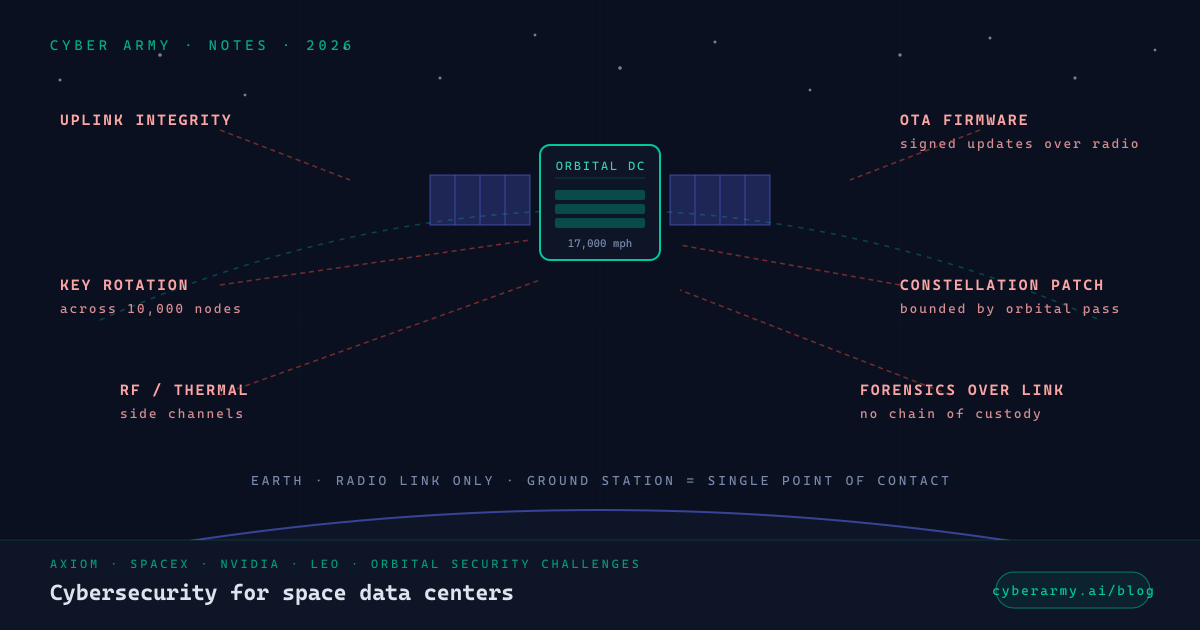
The attack surface of an orbital data center is roughly the same shape as a terrestrial one, with five categories that get materially worse:
- Command and control uplink. Every operational interaction with an orbital data center traverses a radio link, often via a ground station that itself is an Internet-connected facility on Earth. The ground station, the uplink modulation, and the command authentication layer are all attack surface. A compromised ground station hands an attacker direct control of orbital hardware.
- Software updates over radio. Patching a satellite means uploading new firmware or container images over a constrained, latency-sensitive link. Every update path is also a potential malicious-update path. Signature verification, rollback support, and continuity if an update bricks the node are non-trivial when there is no power cycle by physical access.
- Supply chain at integration and launch. Once the satellite leaves the integration facility, the supply chain's opportunity to insert malicious firmware is closed. The opportunity before launch is the lifetime opportunity. The threat model resembles the embedded device world more than the cloud world.
- Side channels via radio frequency and thermal. Adversaries with sensitive receivers and orbital tracking can observe radio frequency emissions and sometimes thermal signatures, and infer significant operational detail. The constellation itself is a high-fidelity public observable in a way a terrestrial colocation rack is not.
- Co-tenancy and constellation-scale attacks. Constellations of hundreds or thousands of nodes share buses, software stacks, ground infrastructure, and update pipelines. A vulnerability in the common stack is a vulnerability everywhere, and rolling out the fix is bounded by orbital pass cadence, not by your patch SLA.
For background on how vulnerability discovery against this kind of homogeneous, hard-to-reach embedded surface looks in 2026, see our writeup of Anthropic's Frontier Red Team research in Inside Mythos. Agentic vulnerability discovery does not stop at the atmosphere.
The cybersecurity challenges this creates
Several distinct operational problems fall out of the orbital constraint, each one a category of work the cybersecurity industry has not standardized.
Patch SLA compression
The window between "CVE published" and "working exploit available" has compressed to hours in 2026, as we wrote in Inside Mythos. Patching a satellite, by contrast, is bounded by orbital pass schedules, ground-station availability, link bandwidth, and validation requirements. The gap between the two is the new exposure window. Standard patch-SLA frameworks (NIST 800-53 SI-2, ISO 27001 A.12.6.1) assume a maintenance window where you take a system offline. Orbital operators cannot easily take a constellation offline. Some operators are exploring rolling patch windows across orbital passes; the practice is not standardized.
Compliance frameworks were not built for orbit
SOC 2, ISO 27001, FedRAMP, and PCI-DSS were authored in a world of terrestrial racks and ground-based ingress. They assume identifiable physical locations subject to a named jurisdiction. An orbital data center crosses every jurisdiction on Earth every ninety minutes. Whose data protection law applies to data processed over the South China Sea? Whose breach notification timeline starts when the breach is detected by ground but the asset is mid-pass? The frameworks have no answers. Insurance carriers are watching this with interest, and the absence of standardized treatment is one of the actual drags on the commercial economics.
Key rotation and cryptographic agility
Best-practice cryptographic hygiene says rotate session keys on a known cadence, rotate long-lived keys on key-compromise or every N months, and have a tested mechanism to switch primitives if one becomes weak. In orbit, every key rotation is a software update over a radio link. Rotating a root signing key on a constellation of ten thousand nodes is an operations problem with significant blast radius if it goes wrong. Post-quantum migration adds urgency because some satellites currently being launched have an expected lifetime of seven to ten years, well within the timeline cryptographic agility planning needs to contemplate.
Forensics and incident response over a radio link
When a terrestrial host is compromised, the forensic playbook involves snapshotting memory, cloning disks, pulling logs, and sometimes physically seizing hardware. In orbit, the available data is whatever the link bandwidth and operational window let you exfiltrate, in the order the satellite chooses to send it, subject to potentially compromised on-board logging. The standard forensic chain of custody assumes you control the medium of evidence transport. In orbit you do not. There is meaningful work being done in the deep-space mission community on this problem, but very little of it has been adapted for commercial data center workloads.
Coordinated disclosure when the device is a satellite
Responsible disclosure for an Internet service usually involves the researcher emailing security@, the vendor patching, and a CVE landing within ninety days. For a satellite, the patch path involves an operations window, regulatory clearance for the firmware push, and a rolling deployment across orbital passes. A ninety day window may not be enough to deploy. A longer window means the vulnerability sits in the wild longer than is comfortable. The industry does not yet have a settled posture on what disclosure timelines look like for orbital hardware. ICS and medical device communities have wrestled with analogous problems for years; their playbooks are a starting point but not a complete answer.
Space is just the extreme version
Here is the part that matters even if you never put a single server in orbit.
The orbital data center is not a special case. It is the most dramatic example of a problem category that already exists everywhere. Edge compute on an oil rig. Sensors in a remote substation. Air-gapped systems in a facility you visit twice a year. Industrial control systems in a chemical plant on another continent. Compromised dependencies in production code rolling out before anyone reads the advisory. Infrastructure scattered across geographies no human will ever physically reach in time.
Every one of these has the same property as a satellite. The standard operational playbook assumes a physical option that is unavailable in practice. The cybersecurity industry has not standardized how to operate in that world, and the result is that real exposure sits open longer than it should.
Space did not invent this problem. Space just made it undeniable. The companies building data centers in orbit are about to learn what operators of remote infrastructure already know.
The data center is going up
The orbital data center is coming. The launches have started. The capital is moving. The hardware exists. The IPO is being underwritten. The cybersecurity questions are going to get answered in production over the next decade, whether or not the industry has a settled posture.
The teams in the best position to operate orbital infrastructure safely are the ones starting to think about the questions above today: how do you ship updates to a fleet of satellites quickly without bricking them, how do you preserve forensic integrity over a low-bandwidth link, how do you handle coordinated disclosure when the affected device makes one pass over your ground station per orbit. None of these are solved problems. Most are not even named problems yet in mainstream cybersecurity.
A note on what we are working on. At Cyber Army we build agentic AI security tooling for organizations that cannot rely on a human being able to reach every host in time. CyberArmy AutoFix is our agentic platform for autonomous remediation across distributed and remote infrastructure, with the same broad-then-deep discovery loop and human verification gate we described in our AI pentest comparison post. We are not claiming the orbital problem is solved; we are arguing it deserves the same engineering attention that terrestrial agentic security is getting in 2026. If you are operating infrastructure that fits this profile, on Earth or above it, the contact page is open.
Cite this post
Plain text or BibTeX:
@misc{cyberarmy_space_data_centers_2026,
  title  = {Cybersecurity for space data centers},
  author = {Shetty, Satish},
  year   = {2026},
  month  = {June},
  url    = {https://cyberarmy.ai/blog/cybersecurity-for-space-data-centers},
  note   = {Accessed: \today}
}
Sources
- Axiom Space orbital data center program. First commercial cloud infrastructure operating permanently outside the atmosphere; first nodes deployed January 2026.
- NVIDIA Data Center Platform. Reference for the company's GPU platform; the orbital-rated variant is the subject of ongoing public coverage as part of NVIDIA's 2026 product line.
- SpaceX updates. Public disclosure on Starlink-derived orbital infrastructure programs and FCC filings for data center constellations.
- FCC Space Bureau. Filings and licensing for satellite constellations including data center applications.
- NIST SP 800-53 rev 5. Security and privacy controls, including patch management (SI-2) and incident response (IR-4) controls referenced in the patch SLA and forensics sections.
- ISO/IEC 27001:2022. A.12.6.1 management of technical vulnerabilities, referenced in the patch SLA section.
- Our previous posts: Inside Mythos on agentic vulnerability discovery and compressed patch-SLA reality; Software supply chain attacks in 2025-2026 on compromise vectors that scale across homogeneous fleets; AI pentest vs manual pentest for context on the broad-then-deep agentic loop.